
Blog
Thaayam: A Traditional Game That Makes Kids Think
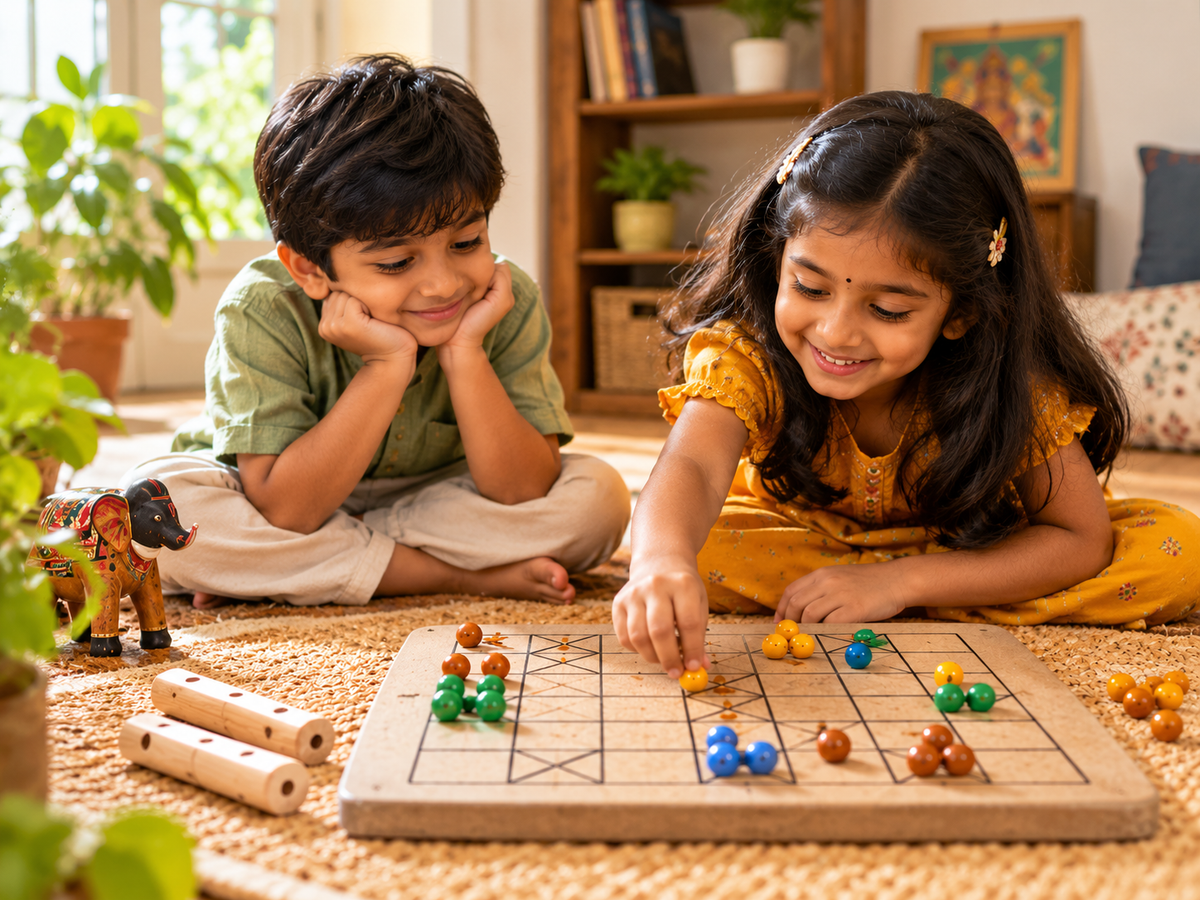
Thaayam is a traditional Tamil board game that combines fun, strategy and learning. Played with simple wooden pieces and traditional dice, it gives children an opportunity to think, make decisions, count and interact with others—all while enjoying a screen-free game.
For generations, traditional games like Thaayam have been part of family play. Today, they can also become a wonderful way to bring children back to hands-on, meaningful play.
1. Develops Strategic Thinking
Thaayam encourages children to think before making a move.
They need to observe the position of their pieces, watch their opponents and decide which move could help them progress. Over time, this encourages children to plan ahead and think about different possibilities.
It is a simple introduction to strategic thinking without making learning feel like a lesson.
2. Improves Concentration
Children need to stay focused throughout the game.
They have to remember where their pieces are, pay attention to the dice and watch the moves made by other players. This kind of active participation can help develop attention and concentration.
Unlike passive screen entertainment, a board game requires children to continuously interact with what is happening in front of them.

3. Makes Numbers Fun
Counting is an important part of Thaayam.
Children naturally practise numbers while counting spaces, understanding dice results and deciding how far a piece can move. This gives them an opportunity to use basic mathematical thinking through play.
For younger children, parents can also use the game to introduce simple counting exercises.
4. Encourages Decision-Making
Every turn presents a choice.
Should the child move a piece forward? Should they try to reach a safe position? Is it better to take a risk or protect an existing piece?
These small decisions help children understand that different choices can lead to different outcomes.
5. Teaches Problem-Solving
Thaayam doesn't always go according to plan.
A player may lose a piece, get a different dice result than expected or find themselves in a difficult position. Children learn to look at the situation, adjust their plan and find another way forward.
This makes the game a playful exercise in flexibility and problem-solving.
6. Teaches Patience and Turn-Taking
Children have to wait for their turn, follow the rules and give other players their opportunity to play.
They also experience both winning and losing.
These simple experiences can help children understand patience, fairness, cooperation and sportsmanship.
7. Creates Family Time
One of the biggest benefits of traditional board games is that they bring people together.
Parents, grandparents, siblings and children can all sit around the same board and play together. Thaayam can become an opportunity for conversations, laughter and shared memories.
In a world where children increasingly spend time with individual screens, a traditional game can create valuable face-to-face family time.

8. Connects Children With Tamil Heritage
Thaayam is not just a game—it is part of Tamil Nadu's long tradition of indigenous games.
Introducing children to traditional games helps them discover how earlier generations played, interacted and spent time together. It can also encourage curiosity about Tamil culture and traditional forms of recreation.
Passing these games from one generation to the next helps keep them alive.
9. A Simple Screen-Free Activity
Children don't need a television, tablet or smartphone to enjoy Thaayam.
All they need is a board, pieces, dice and a few people willing to play.
That simplicity makes it a wonderful screen-free activity for homes, classrooms and family gatherings.
10. Learning Through Play
The beauty of Thaayam is that children don't feel like they are studying while playing.
They are counting without a worksheet, planning without a classroom exercise, making decisions without a test and learning social skills through interaction.
That is the power of traditional play.