
Blog
Mobile Screen Time vs. Traditional Games: What Are Children Missing?
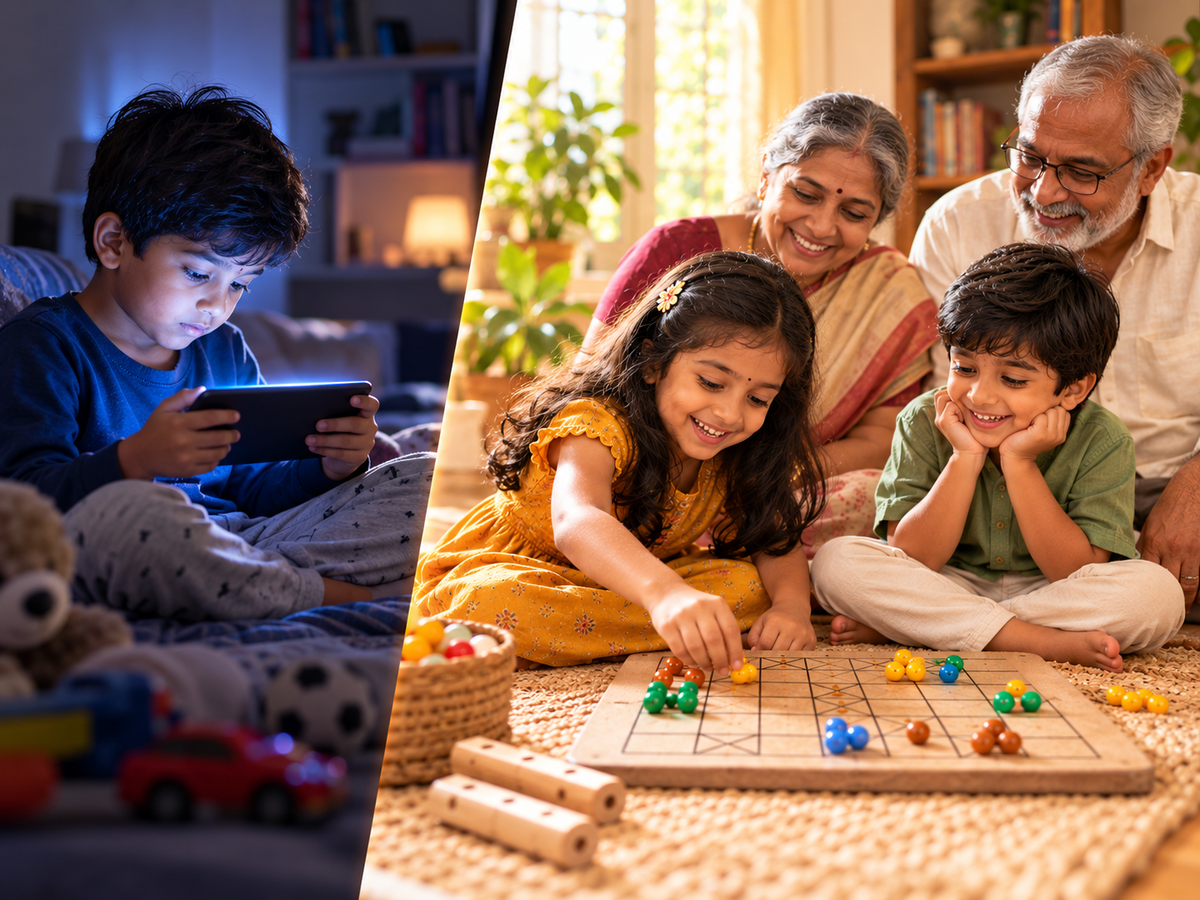
Today, a mobile phone can keep a child occupied within seconds. A cartoon, game or short video is always just a tap away. But when screen time begins to replace playing, moving, talking and thinking, children may be losing some of the experiences that traditional games naturally provide.
This doesn't mean that every screen is harmful or that children need to completely avoid technology. The bigger question is:
What is screen time replacing?
For children, that answer matters.
When the Mobile Becomes the Playground
Screens can be useful for learning, communication and entertainment. But long periods of recreational screen use can take time away from sleep, physical activity, family interaction and play.
The Indian Academy of Pediatrics (IAP) recommends that children below 2 years should not be exposed to screens, while children aged 2–5 years should have a maximum of one hour of supervised screen time a day. For children aged 5–10, the IAP recommends less than two hours a day. It also specifically says screen time should not replace outdoor physical activity, sleep, family and peer interaction, studies or skill development. (PubMed)
The American Academy of Pediatrics similarly recommends limiting high-quality media to one hour or less per day for children aged 2–5, while for older children it recommends creating an individualized family media plan that protects time for sleep, physical activity and other important activities. (American Academy of Pediatrics)

What Does Traditional Play Offer?
Traditional games such as Thaayam, Pallanguzhi, Paramapadham, Aadu Puli Aattam and board games ask children to actively participate.
They have to:
-
Count and calculate
-
Remember rules
-
Wait for their turn
-
Make decisions
-
Plan their next move
-
Observe other players
-
Accept winning and losing
-
Communicate face-to-face
The child isn't simply watching something happen on a screen. The child is part of the game.
Traditional Games Make Children Think
Take Thaayam, for example.
A child throws the Dayakattai and then has to decide which piece to move. Should they move closer to the destination? Should they protect a piece? Can they capture an opponent?
There is luck involved, but there is also decision-making and strategy.
Similarly, games such as Pallanguzhi involve counting, remembering patterns and planning moves.
Traditional games therefore provide opportunities for children to practise thinking skills in a playful environment.
Play Also Means Movement
One of the concerns with excessive sedentary screen use is that it can displace physical activity.
A systematic review of children under five found that screen time was associated with poorer sleep outcomes, while physical activity and outdoor play were favourably associated with many sleep outcomes in toddlers and preschoolers. The researchers also cautioned that the overall quality of evidence was low, so these findings should not be interpreted as proof that screen time alone causes poor sleep. (PubMed)
The WHO recommends that young children have plenty of opportunities for physical activity and limits on sedentary screen time as part of a healthy 24-hour routine. (World Health Organization)
What Do Indian Pediatricians Say?
The Indian Academy of Pediatrics' digital-wellness guideline was developed by a multidisciplinary expert committee that included pediatricians and other specialists. Its message is not simply "remove screens." Instead, it stresses balance.
The guideline recommends that parents encourage physical play, storytelling, music, movement and age-appropriate toys for young children. For older children, it says screen time should not replace play, sleep, family time, studies and other developmental activities. (PubMed)
Pediatrician Dr. D. Srikanth, senior consultant at Yashoda Hospitals, has also highlighted the combination of excessive screen exposure, poor posture and reduced outdoor play as concerns for children's health. (Medbound Times)
More recently, Dr. Manu Sharma, writing for Max Healthcare in September 2026, emphasised that there is no single screen-time limit that fits every child and that parents should consider whether screen use is affecting sleep, physical activity, schoolwork, family time and play. (Max Healthcare)
The Biggest Difference: Playing Together
Perhaps the biggest difference between a traditional game and a mobile screen is interaction.
When children play Pallanguzhi with a grandmother, Thaayam with a sibling or a traditional outdoor game with friends, they are not only playing.
They are talking, negotiating, laughing, waiting, competing and learning from one another.
These are experiences a screen cannot fully replace.

It Doesn't Have to Be "Mobile OR Games"
The goal doesn't have to be eliminating technology.
Instead, families can create a healthy rhythm:
📱 Screen time → 🎲 Game time → 🏃 Active time → 📚 Reading time → ❤️ Family time
The American Academy of Pediatrics' family-media guidance specifically suggests making room for alternatives such as reading, outdoor play, family games and hobbies, so screens don't crowd out other important experiences. (HealthyChildren.org)
🌱 Bring Traditional Games Back
Traditional games don't need expensive equipment, batteries, Wi-Fi or an internet connection.
A wooden board, a few pieces and a family sitting together can be enough.
Thaayam can teach strategy.
Pallanguzhi can encourage counting.
Outdoor traditional games can get children moving.
Family games can bring people together.
In a world filled with digital entertainment, perhaps the answer isn't to take technology away from children—but to make sure technology doesn't take play away from childhood.
🎲 Let them play. Let them think. Let them move. Let them grow.
Jumbo Maama
Less Screen Time. More Game Time. More Family Time.
Editorial note: Screen-time guidance varies by age and organisation, and screen use for schoolwork, video calls and other purposes is not identical to recreational screen use. Parents should consider the child's overall routine rather than focusing only on a single number. (PubMed)